


By Wangpo Tethong, Executive Director ICT Europe
I feel, it is worth telling the story of a woman who lost her father as a child, grew up as a farmer’s daughter in the far east of Tibet, and travelled a long road—from selling butter on the streets of Lhasa and bread in Dharamsala to campaigning across the world for the release of her imprisoned husband.
In March, Lhamo Tso returned to the Netherlands for the first time in many years. She was last in Europe in 2010, traveling from city to city, meeting politicians, NGOs and supporters, seeking solidarity for her husband, Dhondup Wangchen. He had been arrested for producing a documentary about the harsh realities in Tibet in the lead-up to the 2008 Beijing Olympics—a film that would turn their private life into an international cause.
He was released in 2014. But it was not until Christmas 2017 that he finally landed in San Francisco, where Lhamo Tso had settled in the meantime. After nearly a decade of separation, they were reunited as a family—though not the family she once imagined. Years of living apart had left their marks. “We lived separate lives for almost ten years,” she reflects. “Of course, we both changed.”
The emotional cost of those years is difficult to describe. She often wonders how her own life—and the lives of their four children—might have unfolded had events taken a different course. The arrest of her husband not only altered her circumstances; it reshaped her sense of self.
Yet she resists framing her journey as one of sudden self-discovery. By the time her husband got arrested in 2008, she was in her mid-thirties— independent-minded, determined, unwilling to bend easily to expectations. She had never accepted the idea that marriage meant obedience, nor that a woman’s dignity should depend on compliance. When, years later, she was told by an older Tibetan lady to dress inconspicuously as the wife of a “Tibetan hero,” she listened politely— and declined the advise. She angrily recalls: “These blouses and trousers were given to me by one of my in-laws. All second hand clothes. Why would you want to judge a person based on what they wear?”
Her life changed in August 2008. Two Tibetan activists from Switzerland showed her a 25-minute underground documentary on a laptop. It had been filmed secretly by her husband just days before the opening ceremony of the Beijing Olympics. Her unease deepened into certainty. She had not heard from her husband for weeks. Now she understood why. He must have been arrested. She was given a DVD to watch again with her family and was told that they needed her consent to publicise this film. A terrible dilemma – should she honour her husband’s wish to release the documentary, or shield him from torture, a lengthy prison sentence, and further suffering? She decided to respect her husband’s wish and granted her consent.
At the time, Lhamo Tso was living in McLeod Ganj in Dharamsala in India, earning a living by baking and selling bread. Her day began at one o’clock in the morning, kneading dough in the dark. By five, she was climbing the steep road with baskets strapped to her back, selling to Tibetan families. The work was hard but steady. She had no formal education, yet she carried herself with quiet confidence—optimistic, resilient, accustomed to meeting life’s challenges head-on. Then, suddenly, with the disappearance of her husband, she was expected to speak to the world.
Her first press conference in Delhi remains etched in memory. Monsoon rain had flooded the streets. Journalists gathered. The pressure was overwhelming. She knew her purpose: demand her husband’s release. But how should she begin? Where should she look? How do you form sentences when your life has just collapsed? Overcome by emotion, she broke down in front of the many cameras. Her health suffered; she lost weight, depression followed. With the support of her niece Sonam Wangmo who left school and forced her to eat, she slowly found strength. In the end, it was the love she bore for her husband, and the deep responsibility she felt as a wife and mother to her young children, that revived her. It was, however, not an overnight transformation. She tried and failed. It took some time. But it helped that she was driven by the belief that telling Dhondup’s story, speaking about her children and herself, will touch the hearts of the people.
She developed her own way of speaking—direct, personal, unadorned. People listened to her when she shared her memories of her husband, but also about her personal fears, loneliness and responsibility. In doing so, she broke a quiet taboo: displaying public vulnerability is rare in Tibetan society. But many younger Tibetan women felt inspired by her example and their feedback assured her that she was on the right path. Back in Tibet, she says, no one would have asked her to speak on matters of public importance. She was, in her own words, “an uneducated woman.” Yet through telling her personal story, she drew attention to those who are often invisible: the wives and children of political prisoners. Their suffering rarely makes headlines. Their trauma lingers in silence.
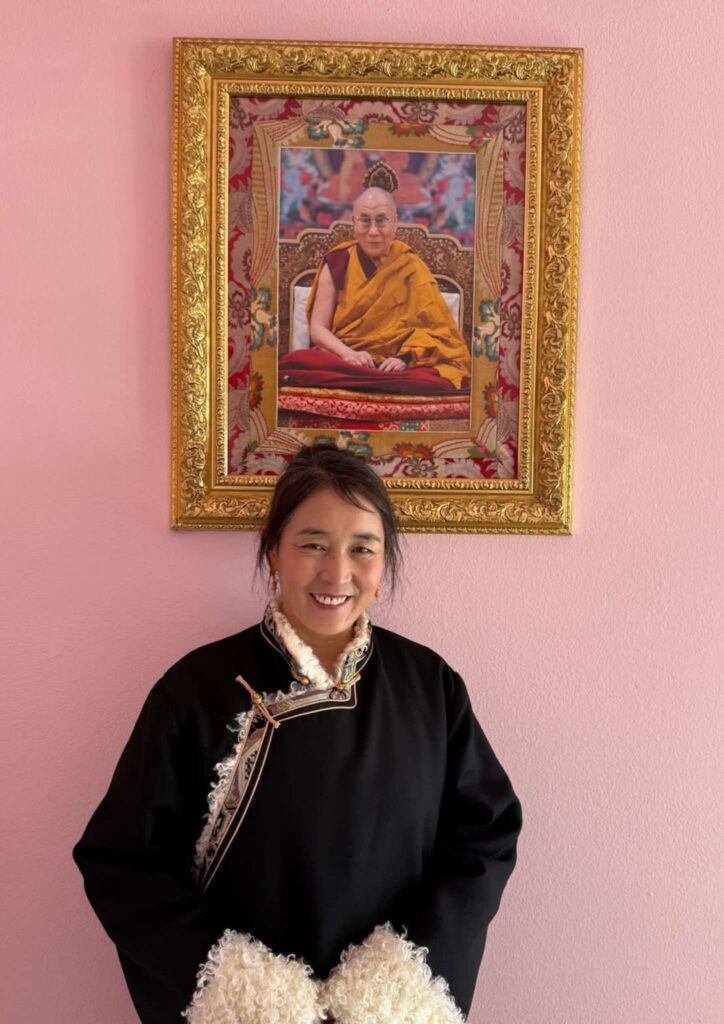
Today, in San Francisco, Lhamo Tso and her husband run a private childcare center for Tibetan immigrant families. This undertaking brought the family together. The children speak Tibetan there; they learn songs, customs and stories from their cultural heritage. When the children call her ‘Genla’—Tibetan for teacher—she smiles. She has no formal training, but she carries the role with pride. Responsibility and purpose, she believes, is not granted by certificates. It grows from experience. Her life has been shaped by forces beyond her control—political repression, exile, separation. But within those constraints, she has insisted on one thing: the right to choose her own path. “Any woman,” she says, “Tibetan or not, should be encouraged to make her own decisions and live the life she feels is right for her.”
Support Tibetan women in their resistance by making a donation!