


Lees het interview in het Nederlands hier
—
China’s influence no longer stops at its own borders. It shapes social media, newsand the lives of many living in Europe. Ardi Bouwersis a recognized China expert and co-author of a study on China’s influence on the local media landscapein the Netherlands. The study brought important insights to light and includes concrete recommendations to the Dutch government. As an advocacy organization being confronted with China’s huge influence in Europe, International Campaign for Tibet Europe (ICT) depends on the media reporting accurately on Tibet. Wangpo Tethong(Executive Director)together with Laila Tara Schumann (Communication Officer) conducted the interview with Ardi Bouwersto get her insights into the situation. The interview took place at Ardi Bouwers’ beautiful townhouse in The Hague on 8 July 2025.
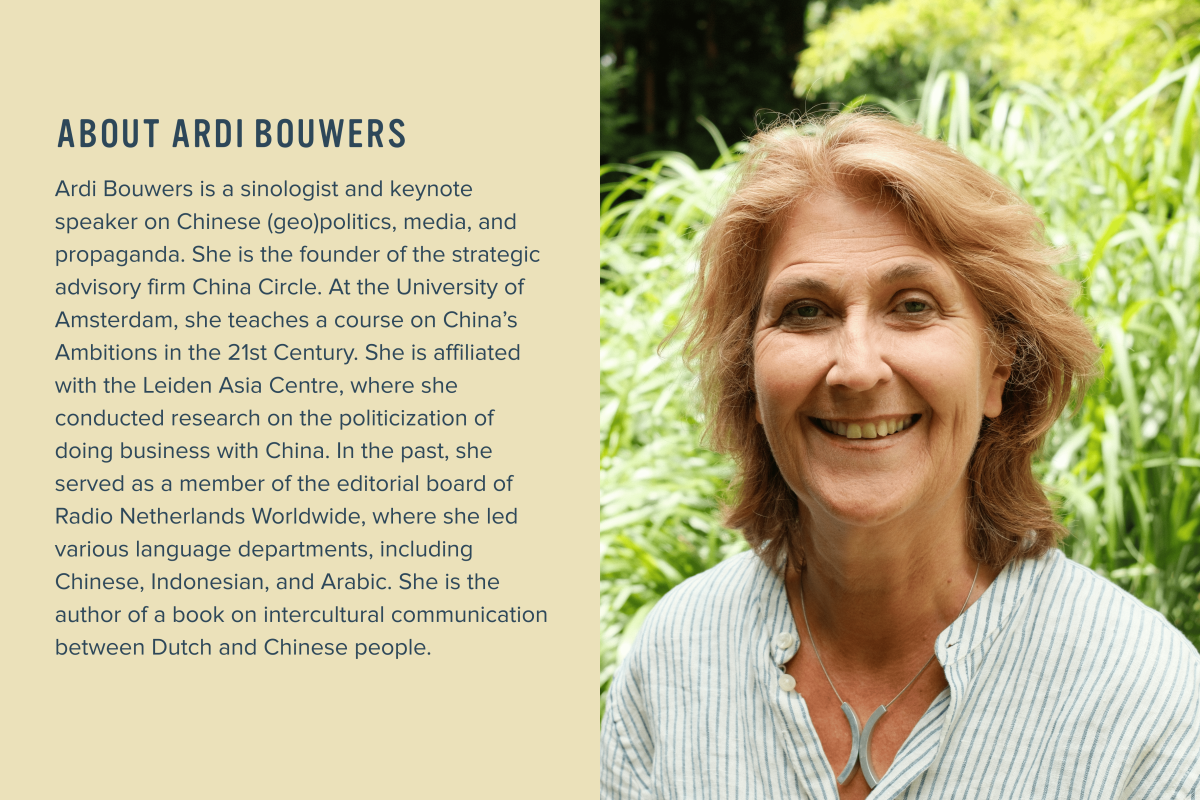
Wangpo: Thank you for taking time to talk with us today. Before jumping into the details of the report, could you please tell us what is your main concern in relation to the findings of your report?
Ardi: Of course. What we’re seeing is that living outside China is starting to feel more and more like living inside China. That’s not just my view, it’s a phrase we quoted from The Economist, and it captures the reality very well. The pressure felt by diaspora communities like Tibetans but also Chinese Human Rights activists or the LGBTQ+ community, as well as Dutch correspondents working in China is hugely psychological. There is a constant feeling of surveillance, either real or perceived, that takes a heavy toll on individuals and free journalism.
Laila: Your report starts with the working conditions of Dutch correspondents in China. What did you find?
Ardi: Yes. Correspondents in China must live with the strong psychological pressure of feeling like they’re being watched, every step they take. Interestingly, while they were there, many accepted the pressure as “part of the job.” But after leaving China, they realized how abnormal and extreme it had been. That perspective also helps us understand what diaspora communities are experiencing in the Netherlands.
Laila: You mention Dutch media aren’t well prepared for this. What surprised you most?
Ardi: I was struck by how little attention there is to psychological pressure. Free press organisations and media-support bodies focus mostly on physical violence or threats, but the massive psychological impact of China’s tactics is overlooked. Mostly, it is left to the individual correspondent to deal with it. That affects the stories that get told and the courage to tell them.
Another issue is the lack of expertise of Dutch editors when it comes to dealing with China and other authoritarian regimes that threaten Dutch correspondents in China but also employ a range of tactics to influence media, including in the Netherlands.
Wangpo: Can you expand on this?
Ardi: To control the narrative, China is trying to suppress undesired information while promoting positive propaganda that pushes China’s success stories and values. With this in mind, Chinese state media, for instance, offers free text, photos and especially video to news outlets. Video is expensive to produce, so if it’s available people just use it, often without realising it comes from Chinese state sources.
A simple example where China invested strongly in shaping the narrative was during the COVID outbreak. China made a huge publicity stunt of sending masks and protective gear to Italy. It was a simple transaction that Italy paid for, but the video report provided from China made it seem like a generous gift. This is what they do, constantly. Pushing their agenda and establishing frames in which reporting takes place.
That lack of transparency is the problem. In the Netherlands, the public broadcaster NOS now keeps Chinese-origin videos in a separate folder, so at least journalists know it might be biased.
Wangpo: We can see a similar approach of China controlling the news from Tibet.
Ardi: Yes. That’s where it’s toughest. No access, heavy censorship, no data. Journalists can’t get stories past their editors without verifiable sources. At best they’ll write about the propaganda tours once, but after that there’s nothing solid to work with. The system is designed to strip stories of their depth.
Laila: And in the meantime, social media fills the gap.
Ardi: Exactly. Influencers and YouTubers push slick videos that travel fast, even if they’re shallow or straight-up propaganda. Serious journalism is slower and less flashy, but the competition for attention is brutal.
‘Legal warfare’ is another method China is increasingly utilizing to silence critical voices. By taking legal actions against journalists, think tanks or organizations, Chinese authorities drain them of their financial resources and time, forcing them to retract their publications and deterring others from taking a critical stance. This also leads to self-censorship.
Wangpo: Economically, China of course will always have the upper hand.
Ardi: Of course. So, what we see is that China is using a combination of tools from technical surveillance, legal warfare, economic coercion and flooding the newsroom with propaganda materials by providing free videos and articles where there is a void of information. Together, these methods are incredibly effective in controlling what stories are being told, even in the Netherlands.
Laila: Earlier you spoke about the psychological pressure China is using to silence people. How does this affect communities like Tibetans and Uyghurs here?
Ardi: The pressure is constant. Tibetan, Uyghur, Hong Kong and Chinese human rights activists in Europe feel it daily. It’s as impactful as physical threats, maybe even more so. Say you’re a Tibetan, a Uyghur, or a Chinese activist living in Europe. Even if nothing happens to you directly, your family back in China might get a knock on the door, a phone call, or someone sitting next to them while they talk to you online. You don’t need that to happen every day for it to weigh on you every day. Increasingly, women are also being targeted whereby their telephone number is published on escort websites leading to them receiving tons of disturbing phone calls. So, there is a potential of being harassed and the sense that someone might be watching, even when you’re not sure. That takes a heavy toll and leads to people withdrawing their statements and presence.
Laila: You’ve called this method “self-censorship”.
Ardi: Exactly. A little bit of pressure on one person makes 100 others hesitate to speak. Over time, whole communities fall silent. That’s not accidental but by design.
Wangpo: What can people do in the face of that?
Ardi: One recommendation we make is: report incidents to the police. Even if it feels frustrating, even if authorities don’t act immediately. If victims across communities file reports, a pattern becomes visible. And once a pattern is documented, authorities can start responding. The system is designed to be vague and deniable, so only by connecting the dots can we expose it.
Laila: If you had to name the first step to improve this situation, what would it be?
Ardi: Editors and journalists need to increase their awareness and understanding of how China works. For editors, there is a responsibility to make sure their journalists and sources are protected from not only physical but psychological pressure too. Journalists need to be able to read in between the lines and understand which stories are told and which not. Journalists who understand the playbook report differently. Collaboration also helps. If media organisations work together, it can make patterns visible and spread the risk. If ten outlets publish the same investigation, it’s harder to sue or intimidate them. Anti-SLAPP* protections are important too, otherwise lawsuits just drain resources.
On the other hand, police and the government need to take individuals seriously who report that they are being harassed in the Netherlands. Individual cases must be recognized as part of a campaign and not just random trolling. Structural knowledge about China needs to be developed and policy made to protect Dutch journalists and vulnerable groups in the Netherlands.
Laila: What about the general reader. How can they be sure they are not just reading Chinese propaganda?
Ardi: Media literacy is key. Be aware of China’s propaganda campaigns and make sure you check your sources. Look not just at the outlet but at who’s writing. Follow people who verify. That is my main advice.
What Ardi makes clear is that China’s actions abroad are not isolated moves but part of a larger strategy of information warfare. Free media content, pressure on journalists, activists and diaspora communities are coordinated tools to control the story well beyond China’s borders. Recognising this as deliberate strategy, not random influence, is essential if we want to push back.
*A SLAPP (Strategic Lawsuit Against Public Participation) is a lawsuit filed to intimidate, silence, or censor critics by burdening them with expensive legal defense costs, rather than seeking genuine justice for a valid claim.
Read the full report “Chinese influence and interference in the Dutch media landscape” here.

Support Tibetans in their struggle for freedom by donating here!