


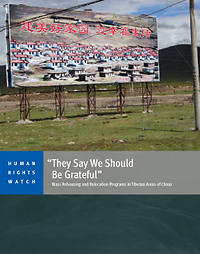
 Since 2006, the Chinese government has implemented large-scale programs to “rehouse”—through renovation of existing houses or construction of new ones—a majority of the rural population of the Tibet Autonomous Region (TAR) under a policy called “Comfortable Housing.” In parallel, the government has accelerated the relocation and sedentarization of nomadic herders in the eastern part of the Tibetan plateau, mostly in Qinghai province, and laid the ground for similar policies in other parts of the plateau. Both policies are a component of the government’s effort to “Build a New Socialist Countryside” in Tibetan areas, which the government says is designed to rapidly increase the living standards of rural Tibetans and boost the local economy.
The scale and speed at which the Tibetan rural population is being remodeled by these policies is unprecedented in the post-Mao era. According to official figures, under the Comfortable Housing policy, 2 million people—more than two-thirds of the entire population of the TAR—were moved into new houses or rebuilt their own houses between 2006 and 2012. Twenty percent of those rehoused between 2006 and 2010—about 280,000 people—had to be relocated, some nearby and others at a great distance. The government intends to rehouse 180,000 more by 2015.
The 115-page report, “‘They Say We Should Be Grateful’: Mass Rehousing and Relocation in Tibetan Areas of China,” documents extensive rights violations ranging from the absence of consultation to the failure to provide adequate compensation, both of which are required under international law for evictions to be legitimate. The report also addresses defects in the quality of the houses provided, absence of remedies for arbitrary decisions, failures to restore livelihoods, as well as a disregard for autonomy rights nominally guaranteed by Chinese law in Tibetan areas.
To read the full report, click here