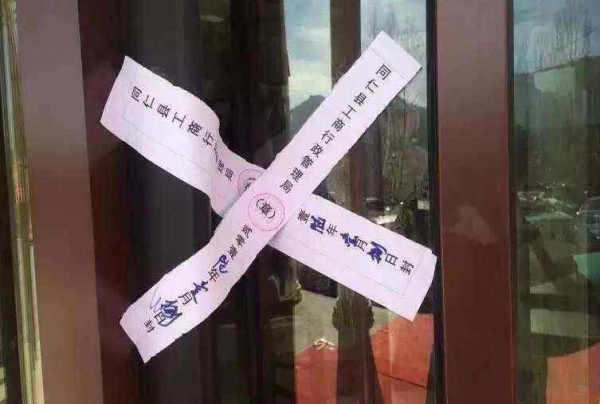
Hotel restaurant closed down by authorities after staff threatened with fine for speaking Tibetan
The sign reads: “Rebkong County Industry and Commerce Management Bureau; Sealed; January 8, 2016”
Following an outcry on social media, the local authorities in Rebkong (Chinese: Tongren), Tibet, have closed down a Chinese hotel after management threatened staff with a large fine if they spoke Tibetan. The hotel, which had only opened last month, made a written apology which was published online, and said that it would be ‘closed for rectification’, indicating that the closure is likely to be temporary.In response to the closure, the county government issued a statement asserting the importance of the Tibetan language and saying that it should have equal status in practice with Chinese, and should be used first. Although both Chinese and Tibetan are the ‘official’ languages in Tibet, when the Chinese authorities use the term ‘bilingual education’ they mean ensuring the dominance of Chinese.
The closure of the hotel in Rebkong and the county government’s response are rare examples of informed comment and objection conveyed via social media leading to a positive outcome. The response by local officials was all the more notable given the harsh political context; last year, ‘protecting the mother tongue’ and organizing Tibetan literacy classes were on a list of activities deemed illegal in a new set of regulations distributed in the Rebkong area in February 2015.[1] The strong responses to the hotel in this case are indicative of the very real fears among Tibetans for the survival of their language, the bedrock of Tibetan culture.
The Xiangyun Pinzhi Hotel in Rebkong, Amdo (administered today by Qinghai province) posted a notice last week stating that all staff were banned from speaking in Tibetan “except for in special circumstances” and if they did so, “offenders will be fined 500 yuan.” 500 yuan is equivalent to $76 at current exchange rates. The notice was photographed and circulated online to widespread outrage among Tibetan netizens, many of whom used Communist Party terminology and legal frameworks to strengthen their argument against it.
One wrote, “In such a harmonious society [a term frequently used by the Chinese leadership to express adherence to the official line], how are there still companies like this?”[2] Another posted: “Is this restaurant, which prohibits employees from having conversations in Tibetan and claims that offenders will be fined 500 yuan, as stated, in compliance with the […] constitutional right of the Tibetan staff to use their ethnic language? […] I urge the relevant authorities, under the leadership of Comrade Xi Jinping, to maintain the constitutional rights of the Tibetan compatriots of our country.”[3]
In an unusual step, the hotel issued an apology that was also circulated online, saying: “This provision seriously hurt the Tibetan people’s feelings, and violated national ethnic policies. This being the case, our Xiangyun Pinzhi Hotel sincerely apologizes to our Tibetan compatriots! We express our full acceptance of Party and relevant local government departments suspending our business for rectification, and while we’re closed for rectification we’re firmly committed to staying in strict accordance with the requirements of the Party and the relevant local government departments, seriously dealing with the relevant personnel, and having a full, deep, thorough, and meticulous rectification within the restaurant. These circumstances will never happen again in the future.”
The Rebkong County People’s Government office in Malho (Chinese: Huangnan) Tibetan Autonomous Prefecture in Qinghai (the Tibetan area of Amdo), issued a formal notice this week (January 11, 2016) stating “To the respective organs, enterprises, and work units: To standardize and strengthen the use of spoken Tibetan at work, it is hereby requested that official stamps, plaques, certificates, slogans, emblems, official documents, envelopes, and advertisements of the respective organs, enterprises, and work units must be bilingual in Tibetan and Chinese.” The document also specified that: “When written horizontally, Tibetan must be on the top, with Chinese on the bottom.” (Full translation below).
In raising their concern about these management regulations, the Tibetan netizens who posted on social media were making a broader point on concern for their language. Tibetans seek to preserve their language by giving it at least equal footing with Mandarin. But to Chinese officials, ‘bilingual education’ policy provides that Chinese is the main language of instruction, with Tibetan relegated to just Tibetan language class.[4]
Not only did the fines for hotel staff for speaking Tibetan contravene the Chinese Constitution, but the new regulations in 2015 criminalizing individuals who gather together to learn and speak Tibetan do so too. Article Four of China’s Constitution states: “All nationalities have the freedom to use and develop their own spoken and written languages and to preserve or reform their own folkways and customs.” The hotel notice also contravened the Law on Regional Ethnic Autonomy, which states in Article 10: “Autonomous agencies in ethnic autonomous areas guarantee the freedom of the nationalities in these areas to use and develop their own spoken and written languages and their freedom to preserve or reform their own folkways and customs.”[5]
The hotel management had originally posted the ruling under the header ‘Five High-Voltage Lines’, a phrase which may have been used in order to demonstrate allegiance to language sometimes used by senior Party officials to describe important regulations. This term was used last year by Tibet Autonomous Region Party chief Chen Quanguo to refer to the imperative of extinguishing inner loyalty to the Dalai Lama among Tibetan officials and preventing them from attending teachings in exile, as the importance of the “anti-separatist struggle” was emphasized at the highest levels in Beijing.[6]
In Rebkong, Tibetan students and laypeople have initiated a number of peaceful demonstrations in defense of their language, the bedrock of Tibetan religion, culture, and national identity. In 2010, protests by Tibetan schools and college students over plans to restrict the use of their language that spread from several areas of Qinghai to Beijing began in Rebkong.[7] All sectors of society – students, farmers, monks, nomads, teachers, and children – came together to make reasonable and measured demands for change.
There have been a number of self-immolations by Tibetans in Rebkong, which has been followed by spontaneous gatherings of thousands of Tibetans on several occasions to pray and pay their respects. On November 9, 2012, amidst a tense security situation, thousands of Tibetan students in Rebkong gathered at the cremation of a Tibetan nomad and former monk, Jinpa Gyatso, who self-immolated and died the day before in front of Rongpo monastery. Images received from Tibet showed children in the demonstration holding hands amid crowds of thousands. Similarly, thousands of Tibetans gathered in Dowa township in Rebkong to say prayers for Nyangchag Bum, one of two Tibetans who self-immolated and died on Monday, November 12, 2012. The second Tibetan to set fire to himself on November 12, 2012 in Rebkong, expressed his concern about the Tibetan language in a note he left. The note expressed in part his hope that “six million Tibetans study Tibetan, wear Tibetan clothes and be united.”[8]
Translations
A translation of the notice issued by the Rebkong authorities by ICT from Chinese into English is enclosed below:
Notice
To the respective organs, enterprises, and work units:
To standardize and strengthen the use of spoken Tibetan at work, it is hereby requested that official stamps, plaques, certificates, slogans, emblems, official documents, envelopes, and advertisements of the respective organs, enterprises, and work units must be bilingual in Tibetan and Chinese. The Tibetan language must be used in the following formats:
When written on a curve, Tibetan must be on the outside, with Chinese on the inside.
When written horizontally, Tibetan must be on the top, with Chinese on the bottom.
When written vertically, Tibetan must be on the left, with Chinese on the right.
The font and size the two languages are written in must be consistent. This work must be completed by January 13, 2016.
Rebgong County People’s Government Office
January 11, 2016
The following letter of apology by the hotel in Rebkong was circulated online and is translated from Chinese into English by ICT below:
A letter of apology
Respected Tibetan compatriots and people of this county:
After opening in December 2015, Xiangyun Pinzhi Hotel hired a management team from another area, which introduced a management system including this proposed provision: “In work areas all staff are prohibited from having Tibetan-language exchanges, except for in special circumstances. Offenders will be fined Y500.” This provision seriously hurt the Tibetan people’s feelings, and violated national ethnic policies. This being the case, our Xiangyun Pinzhi Hotel sincerely apologizes to our Tibetan compatriots! We express our full acceptance of Party and relevant local government departments suspending our business for rectification, and while we’re closed for rectification we’re firmly committed to staying in strict accordance with the requirements of the Party and the relevant local government departments, seriously dealing with the relevant personnel, and having a full, deep, thorough, and meticulous rectification within the restaurant. These circumstances will never happen again in the future. We hope the public will be understanding and help us- the entire staff of the Xiangyun Pinzhi Hotel once again expresses our sincerest apologies to our compatriots!
An extract from one of the social media posts about the matter is translated into English below. After posting the text of relevant laws and a quote from Xi Jinping about the Constitution, it ends with these questions:
“I ask the relevant authorities: Is this restaurant, which prohibits
employees from having conversations in Tibetan and claims that offenders will be fined 500 yuan, as stated, in compliance with the Constitution?
Has the hotel administration violated the constitutional right of the
Tibetan staff to use their ethnic language?
If so, I ask whether the authorities will follow up on this matter, punish the people concerned and educate them on the Constitution?
I urge the relevant authorities, under the leadership of Comrade Xi Jinping, to maintain the constitutional rights of the Tibetan compatriots of our country.”